
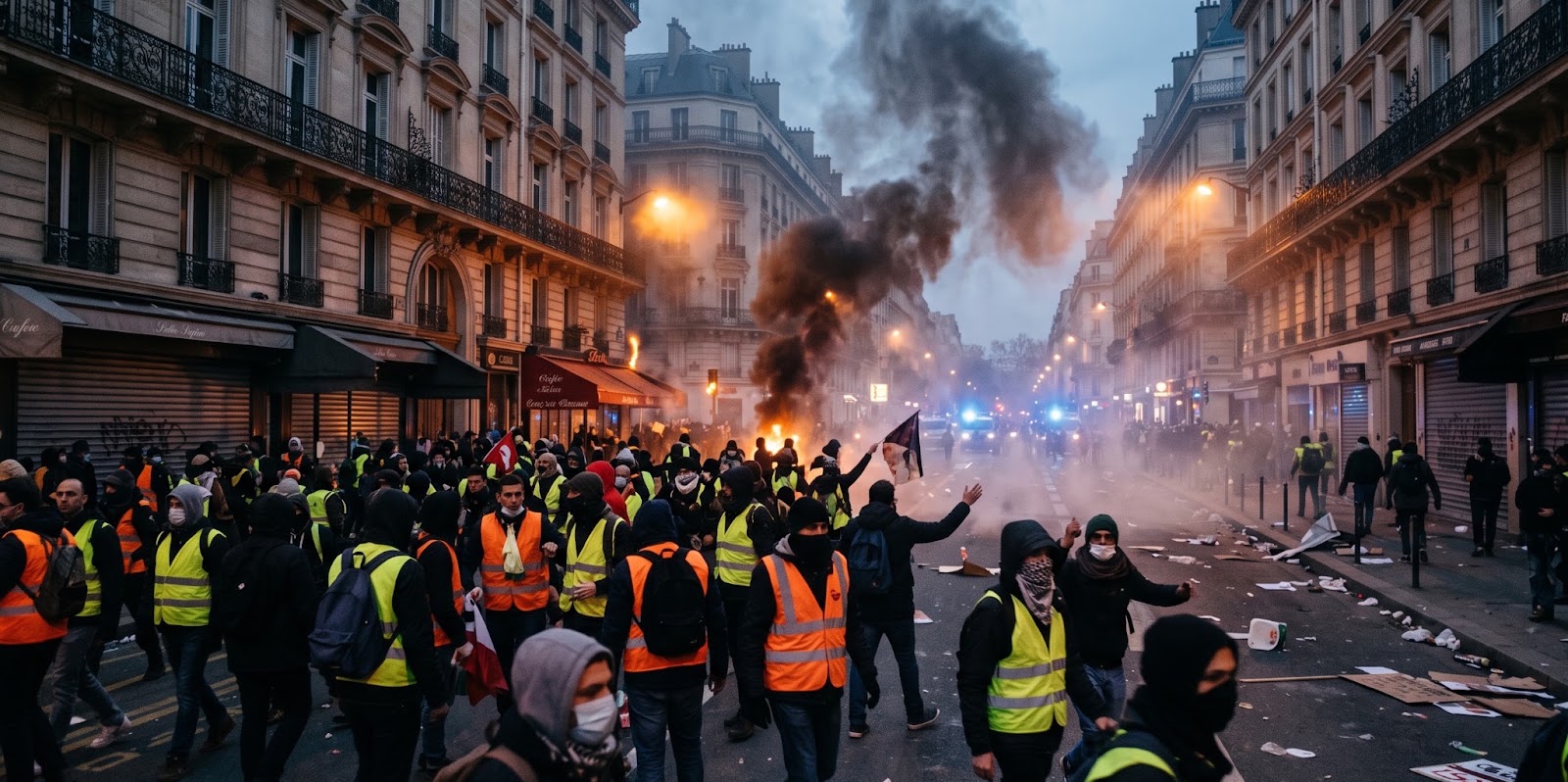
Over the weekend, Limoges City Hall, a nineteenth-century building in France, was nearly destroyed by fire during the unrest. In Paris, Lyon, and Marseille, we saw looted businesses, burned cars, and streets overtaken by violent groups. Authorities estimate that more than 3,000 businesses suffered damage or theft.
The demonstrations began over the cost of living, conditions in schools, and the deterioration of public services. Hundreds of thousands of people took to the streets, most of them peacefully. But some groups turned a legitimate expression of frustration into something else entirely: an attempt to impose their will through violence. Interior Minister Laurent Nuñez acknowledged that police lost control in some cities and that authorities had failed to anticipate the scale of the unrest.
Why am I sharing this?
Because when a protest ends up paralyzing and destroying its own city, who is really being punished? And because, beyond the images, I think France illustrates a problem that is growing in many societies: the expectation that the government should behave like a parent responsible for taking care of everything. Pensions, education, healthcare, housing, energy, and financial assistance. Citizens are right to expect public services that work. But every government promise comes at a cost. France does not have an unlimited checkbook.
Consider the numbers. In 2025, taxes and compulsory social contributions amounted to 43.6% of French GDP. According to the OECD, for a single worker earning the average wage, income taxes and social contributions paid by the employee and employer together represented 47.2% of the total cost of employing that person. That does not mean 47.2% was deducted from the employee's paycheck. It measures the overall tax burden on employment, among the highest in the OECD.
And is that enough? Unfortunately, no. Public spending reached 57.2% of GDP in 2025, the deficit was 5.1%, and government debt had climbed to 119% of GDP by the second quarter of 2026.
Bond markets have begun reflecting that pressure. In October 2024, the benchmark yield on French ten-year debt was around 2.93%. A year ago, it was 3.31%. This Monday, it reached roughly 4.9% during the trading session. In simple terms, financing is becoming more expensive. It does not mean France is about to default, but it does show growing concern about its finances and political uncertainty.
This is where public anger runs into an uncomfortable reality. France already collects a great deal in taxes, spends even more, and continues to add debt. So where will the money come from to meet every demand?
Raise taxes and you risk increasing public frustration. Borrow more and financial markets may become even more concerned. Cut spending and you risk further unrest in the streets.
That is the vicious circle France appears to be trapped in.
Personally, I believe we should demand very strong reasons before allowing the government to assume more control or manage still more resources. Good intentions are not enough. Where is the accountability? How do we measure efficiency? Who answers when a program costs more every year without delivering the results it promised? The same applies to certain public-sector benefits and retirement commitments. This is not a criticism of public employees. It is a question of sustainability. Private companies have to reconsider benefits they can no longer afford. Why shouldn't governments face the same obligation to account for the promises they make?
But another contradiction troubles me just as much as the finances. Yes, there is legitimate anger, and yes, there are real problems. Neither justifies destruction or depriving fellow citizens of their ability to work, travel, or simply go about their lives. The city does not belong to the president. The public school does not belong to a minister. Transportation, public squares, shops, libraries, streets, and hospitals are not abstract symbols of power. They are part of everyone's daily life and when they are destroyed, the system is not necessarily brought down.
The citizen is weakened.
France is a reminder that a cause can have valid arguments and still lose sight of them when some choose to impose it through violence. Governments have responsibilities to their citizens. Citizens do not stop having responsibilities simply because they are angry.
I wish you an excellent start to your week, and as always, thank you for your comments and questions.

 LinkedIn
 Instagram