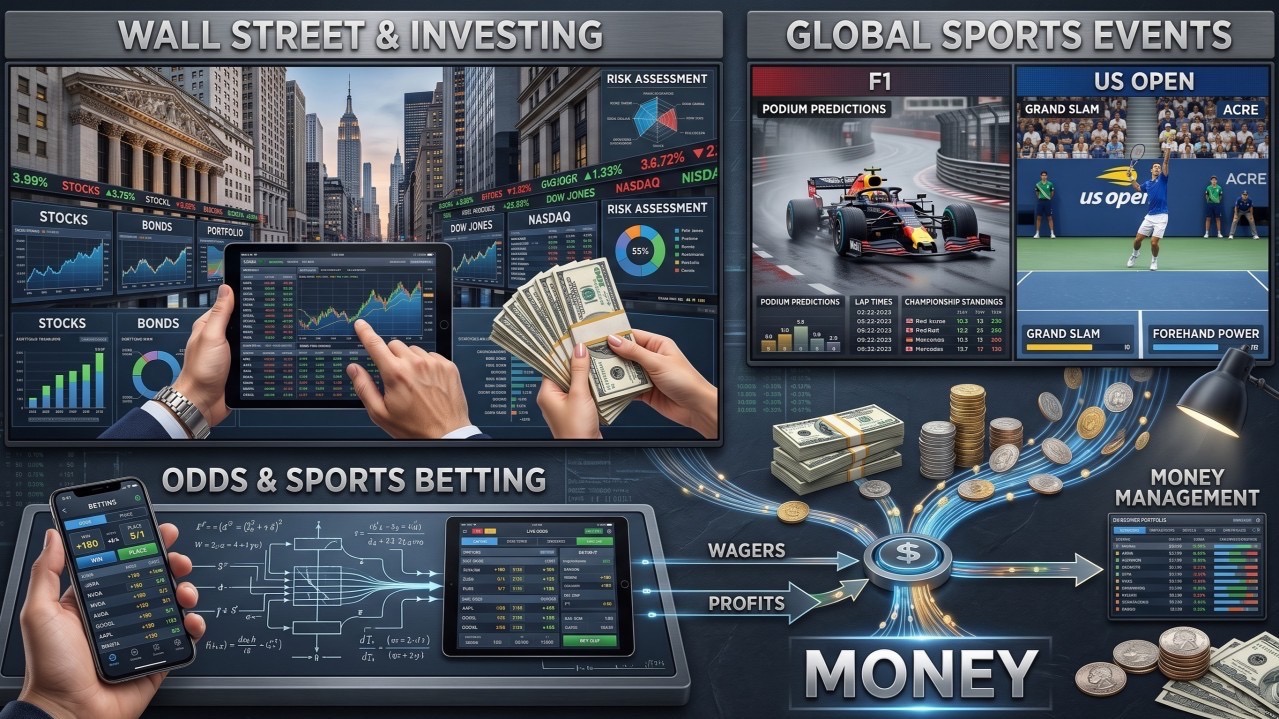
Sunday was a great day for those of us who enjoy sports at the highest level. We had the US Open, where 23-year-old Ben Shelton reached the final for the first time to face 29-year-old Alexander Zverev. We also had Formula 1 with the Madrid Grand Prix.
What can we learn from what happened in these events?
At the beginning of the tennis tournament, Shelton was given roughly a 10% probability of reaching the final. Similar to what I wrote about the World Cup, as matches are played and more information becomes available, probabilities adjust. By the time he defeated Carlos Alcaraz, his chances had increased considerably, and when he reached the final, his probability of winning was 45%.
In Formula 1, Lando Norris started from Pole Position and was controlling the race with strong pace and a solid strategy. On lap 13, Lance Stroll had an accident, triggering a Virtual Safety Car. All drivers were required to immediately reduce their speed while Stroll’s car was removed.
The problem for Norris was timing.
The Virtual Safety Car was announced just as he was passing the pit entrance. The drivers behind him were able to take advantage of the situation, enter the pits, and lose considerably less time than they normally would during a pit stop.
We could simply call it bad luck, but the fact remains that Norris lost the lead and, after driving a great race, finished third.
Both Shelton and Norris are excellent at what they do. The same is true of many companies trading in the stock market.
Just like in sports, a great company does not always “win.”
A company can be doing an excellent job controlling costs, serving its customers, and gaining market share, and then something outside its control happens. Much like the Virtual Safety Car for Norris, suddenly the circumstances change.
We are currently seeing airlines, cruise lines, and transportation companies under pressure because of oil prices. Not necessarily because they are doing something wrong, but because something beyond their control has changed the environment in which they operate.
Other times, companies lose simply because a competitor is doing something better.
That is what happened to Shelton against Zverev. Zverev was simply better that day. But that does not mean Shelton is not a great player. The same principle applies to companies and investments.
Why am I sharing this with you?
Because a good decision can produce a bad outcome.
In times of volatility and uncertainty, we need to learn to live with both. We cannot prevent something unexpected from happening, but we can build a portfolio prepared for different scenarios.
Investing under the assumption that nothing will ever go wrong would be a mistake. The better approach is to manage risk, reduce volatility when possible, and understand that eventually, some investment will not perform as we expected.
For my part, I know that at some point an investment will produce a different result from the one I anticipated. My responsibility will be to determine whether the investment thesis has changed or whether the environment around it has simply changed. Then I need to look for the best alternative and, most importantly, learn from what happened.
The objective is not to build a portfolio where nothing can go wrong. That portfolio does not exist.
The objective is to build one that can continue serving your priorities even when something does go wrong.
That distinction matters.
A bad outcome does not necessarily mean the decision was bad, just as a good outcome does not necessarily prove the decision was right. Sometimes we make the right decision and circumstances work against us. Other times, we make a poor decision and luck temporarily makes us look brilliant.
Investing, like sports, requires us to separate the quality of the decision from the outcome of a single event.
Because in the long run, we cannot control every outcome. What we can control is how prepared we are when the unexpected happens.
Have an excellent start to your week. And if this newsletter gave you something to think about, share it with someone who might find it interesting as well.

 LinkedIn
 Instagram